2026-03-28


私の立体作品は、器類や実用品的な形式を用いながら、その機能性から離れたところで制作されています。 ここでの関心は、物を「作る」ことそのものではなく、素材が生成し、時間が物質として立ち現れるプロセスにあります。 

やきものの制作において、素材は工程ごとに性質を変え、特に焼成によって不可逆的な変化を起こします。窯の中で起きる現象は制御しきれるものではなく、完成した姿は常に予測を超えて現れます。 そのようにして立ち現れた表情に対して、観察し、応答し、さらに層を重ねていく。この反復の中で、作品は次第に意図や操作から離れ、素材と時間が関係の中で成立するものとして現れてきます。 

表面に見られる複数の層は装飾ではなく、時間の堆積そのものです。 窯の中では、長い年月をかけて起こるような変化が短時間のうちに凝縮して現れます。 そのため時間は外から付加されるのではなく、物質の中に刻まれた構造として存在しています。 

また、器という形式は本来、人が環境と関係を結ぶための起源的なかたちです。本作ではその機能を無効化することで、使用以前、あるいは関係の痕跡のみが残された状態を立ち上げています。それは実用品としてではなく、人がどのように世界と関わってきたのかを問い返す存在です。 

こうした作品は、明確なメッセージを提示するものではなく、むしろ個人の空間の中で長い時間を共にすることによって、その見え方や意味が変化していきます。 使うための器ではなく、時間や感覚の変化に寄り添いながら関係を結び続ける存在として位置づけられます。


My works employ forms derived from vessels and utilitarian objects, while being produced outside of their functional context.

The focus here is not on the act of “making” objects itself, but on the processes through which materials generate and time emerges as a material presence.

In ceramic practice, materials transform their properties at each stage, undergoing irreversible change particularly through firing. The phenomena that occur within the kiln cannot be fully controlled, and the final outcome consistently exceeds prediction.

By observing, responding to, and further layering upon the surfaces that emerge in this way, the work gradually moves away from intention and manipulation, coming into being through the relationship between material and time.

The multiple layers visible on the surface are not decorative, but rather accumulations of time itself.

Within the kiln, transformations that would normally unfold over long durations are condensed and occur within a short span.

Thus, time is not something externally added, but exists as a structure inscribed within the material.

Furthermore, the form of the vessel originally functions as a primordial means through which humans relate to their environment. In this work, that functionality is deliberately suspended, giving rise to a state that exists prior to use, or in which only traces of such relationships remain.

It is not an object for practical use, but a presence that invites reflection on how humans have engaged with the world.

These works do not present explicit messages; rather, they are intended to be lived with over time within personal spaces, where their appearance and meaning may gradually shift.

They are not vessels to be used, but entities that continue to form relationships, accompanying the passage of time and the subtle changes of perception.


線/Lines 
[2022.9]

本作は、蔓植物を採取し、それらを泥漿に浸して焼成した磁土ピースを、糸で吊り下げ、立方体状の空間に構成した作品です。 
蔓植物は、成長の過程において螺旋や分岐といったリズムを内包しており、個々は不規則でありながら、ある種の秩序を感じさせる形態を持っています。本作ではそれらの断片を一度焼成によって固定し、空間内に整列させることで、自然物の集積からゆるやかな秩序が立ち上がる状態をつくり出しています。 
作品の構造として用いている立方体は、自然を切り取るための人為的な枠であると同時に、結晶構造のように自然の内部にも見出される基本的な構造の写しでもあると考えます。この枠組みの中に有機的な形態を配置することで、自然に内在する秩序と、人為的に与えられる秩序とが交差する場を提示しています。 
また、各パーツは糸によって吊られており、空気の流れや鑑賞者の動きによってわずかに揺れ動きます。構造は立方体として規定されていながらも、その内部は常に流動的で確定せず、時間の中で関係性が更新され続けます。 
鑑賞者の視点によって、構造は平面的な層としても、奥行きを持つ立体としても知覚され、その見え方は固定されません。また、密に見える集合体は同時に多くの空隙を含み、存在のあり方に対する意識を再認識するきっかけともなります。


This work is composed of porcelain elements made by collecting vine plants, immersing them in liquid clay, and firing them. Each piece is suspended by thread and arranged to form a cubic spatial structure.

Vines embody rhythms such as spirals and branching through their process of growth. Although each element is irregular in form, they suggest a certain inherent order. In this work, these fragments are fixed through firing and then aligned within space, allowing a gentle order to emerge from the accumulation of natural forms.

The cube, employed as the structural framework, can be understood both as an artificial device for framing nature and as a reflection of fundamental structures found within nature itself, such as crystalline formations. By placing organic forms within this framework, the work presents a field in which inherent natural order and imposed human order intersect.

Each element is suspended by thread and responds subtly to air currents and the movement of viewers. While the overall structure is defined as a cube, its interior remains fluid and indeterminate, with relationships continuously shifting over time.

Depending on the viewer’s perspective, the structure may appear as a flat plane or as a volumetric form, and its perception is never fixed. What appears as a dense aggregation simultaneously contains numerous voids, prompting a reconsideration of how we perceive presence and existence. 


2024-09-20


隊列を組み飛んでいく渡り鳥の群れ。

あるタイミングで一斉に方向を変化させる魚群。

隙間なく並ぶ植物の種子や意思を持っているかのように延びる蔓。


ありふれた風景の一部として眺める自然現象がときに、まるでなにかの自動運転によって

動かされているかのように感じてハッと我に返るかのように驚かされることがあります。

そしてまたあらためてじっくりと観察していくと、自分の中に対象物の感覚が入り込み

そのイメージと自身の境界があいまいになるような錯覚をも覚えるのです。


「自然をふつうに見ますと単に自然が見えるだけです。しかし、仔細に見ますといちいち

いかにもふしぎなのです。(中略) このようなものを人はつくることもできなければ、

説明することもできません。わたしたちは、このつくれそうもないことわかりそうも

ないことに目 をふさいでいるがゆえに、すべて知っているように思いますが、仔細に

見ると自然はこのようなふしぎにみちているのです。このふしぎまで見ることのできる

人が自然を見ますと、単に自然を見ているだけではなく自然あらしめているものも同時

に見ているのだといえます。」 (「 風蘭」1964年 ― いのち ―/岡潔 )


数学者の岡潔氏が記述したこの一節は、一連のインスタレーション作品において自分が

何を掴もうとしたのかを気づかせてくれることばでもあります。さまざまな様相の磁土

ピースを整列させてみたときに出現する景色は、一見無秩序な自然物をじっと観察して

いたとき、ある瞬間、その奥行きの先にある世界の大きな存在を垣間見たような自らの

体験を重ねようとしていたものであるのだと振り返ります。また対象物の観察を通じて

得られる体験は、自分もまた氏の言う「自然あらしめているもの」一部であり、それ

によって成されているのだと気づくことでもあります。


「まことに人とはふしぎなものです。(中略)わたしたちは、それを意識していないの

ですが、きわめて具体的に情緒(意志的情緒)を物質(肉体)にする。つまり、物質によっ

て四次元的に表現する力をもっています。」 (「 風蘭」1964年 ― いのち ―/岡潔 )


岡潔は、ふだん私たちが何気なく行う動作においても、その意志と肉体の動作が自然

と通じ合うふしぎさについて同著で触れています。自分もまた自然的存在でもあると

いう感覚に身を置くこと、自分の体感が世界のありようと重なっていくような感覚を

写すことがこれらのインスタレーション作品に共通し意図するところです。

そしてまた制作においても、用いる対象素材を丹念に観察し自分の動機と密に関わって

いくことで、自分の感覚と物質が互いに絡まり合う体験があります。そうして生み出さ

れる造形物 は、人が世界で生きていくためのものづくりの原型の姿とも映り、悠久の

時空を想像する感覚や 自分自身のなかに脈々と流れるヒトが受け継いできた何かを

実感することでもあるのです。


Flocks of migrating birds flying in a “V”.

A school of fish that changes direction in unison.

Seeds arranged neatly in berries, and vines that extend as if t hey have a will of their own.


Natural phenomena that I see as part of the ordinary scenery so metimes startle me back to my senses as if they are being driven by some external force. And when I look at it again carefully, I feel as if t he sensation of t hat force has entered my mind and the boundary between the image and myself has become blurred.

“When we look at nature in an ordinary way, we simply see nature. But when we look at it in detail, it is very mysterious. (omission) We cannot create such things, nor can we explain them. We think we know everything because we don’ t look carefully at the things we cannot create or understand, but when we look closely, we find that nat ure is full of such mysteries. When a person who can see these mysteries looks at nature, he or she is not only looking at nature, but is also looking at what makes nature what it is.”  (“Fūran”1964.  ‒Inochi‒/Kiyoshi Oka)


This passage, described by mathematician Kiyoshi Oka, reminds me what I was trying to figure out in my series of installation works.I understand th at the views that emerge when I arrange the various shapes of the porcelain piece s are an attempt to superimpose my own experience, as if at a certain moment when I was observing a seemingly random natural object, I caught a glimpse of the world beyond the depth of the object. My experience gained from observing the object is the realization that I am also generated by what he calls “what makes nature what it is”.

"We are indeed a mysterious thing, he said. (omission) We are not conscious of it, but We very concretely make emotion (willful emotion) into matter (body). In other words, we have the power to express ourselves in four dimensions through matter."(“Fūran”1964.  ‒Inochi‒/Kiyoshi Oka)


In the same book, Kiyoshi Oka describes the mysteriousness of t he natural connection between our emotion and our physical actions, in the actions we perform without thinking about them. The common theme of these installation work s is to place myself in the feeling that we are also a natural being, and to feel the sensation that my own physical experience overlaps with the state of the wo rld. In the process of creation, I observe the materials carefully, there is an experience of my s enses and matter intertwining with each other, becoming intimately involved with my motives. The objects created i n this way can b e seen as the p rototypes of th e w ay p eople make things in order to live in the world, and they are a way of ima gining a timeless space and time, and of realizing something that has been passed down from generation to generation in the human body.


2024-04-21


積層/layers

和紙に白磁泥漿を塗布し、一枚ずつ焼成した断片を積層した磁土の立体です。 乾燥と焼成の過程で生じる歪みや反りを、そのまま形として留めています。 表面の銀彩は時間とともに硫化し、古紙のような色合いへと変化していきます。 紙が記憶や情報を宿す媒体であるように、土もまた外界からの影響を受け、その痕跡を内包します。 この重なりは、紙片の気配と、それぞれの時間を写し取っています。 その佇まいは風をはらんだ一瞬のかたちでありながら、固定されたものではありません。 変化を続ける表情のなかに、複数の時間が折り重なり、静かに堆積していきます。

This sculptural form is composed by layering fragments of porcelain slip applied to washi paper and fired individually.
The distortions and warping that occur during drying and firing are preserved as part of the form.
The silver surface undergoes sulphidation over time, gradually developing tones reminiscent of aged paper.

Just as paper serves as a medium that holds memory and information, clay also receives influences from its surroundings and contains their traces.
This accumulation captures the presence of paper fragments along with the traces of their respective times.

Its appearance evokes a fleeting moment, as if sheets of paper were caught in the wind, yet it is not fixed.
Within its continually changing surface, multiple layers of time overlap and quietly accumulate.


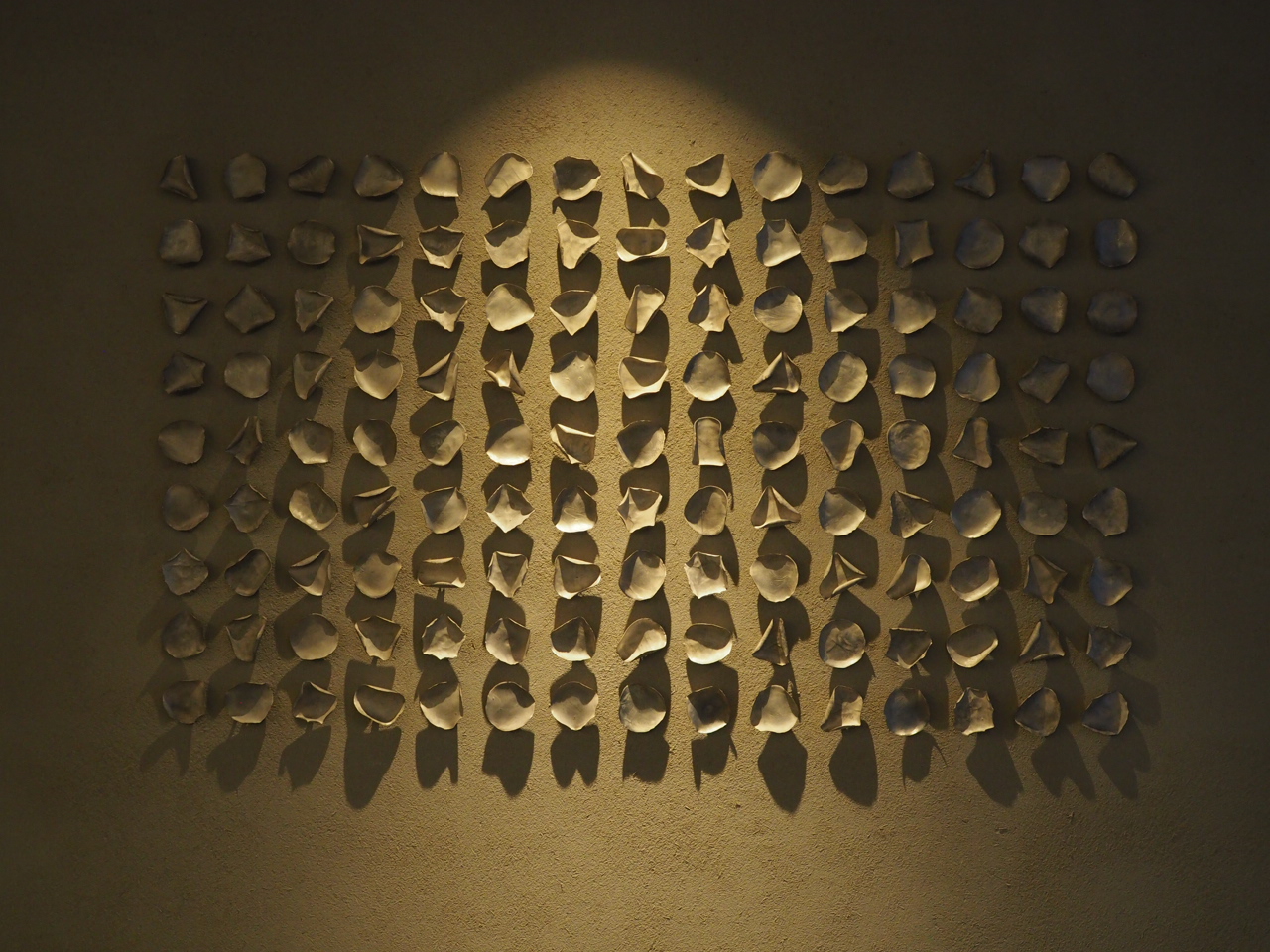
点/dots   [2022.9]

自然の奥深くには、なにか一定の法則が宿っているように感じることがあります。

様々な様相の磁土片を整列させてみたときに現れる景色は、一見無秩序な自然物対象をじっと観察していたとき、奥行きの先にある世界の大きな存在を垣間見たような時の印象をイメージしています。

磁土片は、和紙片に白磁泥漿を塗布し焼締め、銀彩を施したものです。
泥漿の乾燥時収縮により各々形が変化します。


Deep within "nature" there is a sense that there are certain laws that exist.
The scenery that emerges when I arrange the various aspects of the clay pieces is reminiscent of the impression I get when I observe a seemingly chaotic natural object and catch a glimpse of the world beyond its depths.

The porcelain clay pieces are pieces of Japanese paper coated with white porcelain mud plaster, fired, and painted with silver.
The shape of each piece changes as the wet porcelain clay dries and shrinks.


棒/sticks

現代を生きるわたしの中にも、ふと古来の狩猟民族であった人類の血が流れていることを思うことがあります。
生活のために何かを採取したり加工したりする、そういった何かのきっかけで感じる好奇心や高揚感などの感覚に気づく時、自分に受け継がれてきた人々と交信したような気分になり、多くの人々の存在や生活の景色が想像に浮かびます。

造形素材としてやきものを扱う上で「うつわ」は尤もなこととしてありますが、わたしにとっては一本の棒から、ヒトと道具の起源を想像することが、うつわをも含む道具のはじまりのように思い、一本の棒を起点に、造形も動作もさまざまに展開することを考えます。 わたしにとっての「棒」はモノづくりの原風景を象徴するかたちです。

I sometimes think that I, who live in the modern age, have the blood of ancient hunters running through my veins.

When I become aware of the sense of curiosity and elation I feel when I gather or process something for daily living, I feel as if I am communicating with the people who have been handed down to me, and the existence of many people and the scenery of their lives come to my imagination.

When dealing with ceramicist as a material for modeling, it is natural to think of a "vessel", but for me, imagining the origin of "humans and tools" from a single stick is like the beginning of tools, including vessels, and I think of the various developments of modeling and movement that can be made from a single stick. I think of the various ways in which the form and action of a sticks can evolve from its starting point. For me, "stick" is a form that symbolizes the original landscape of manufacturing.


2022-05-07

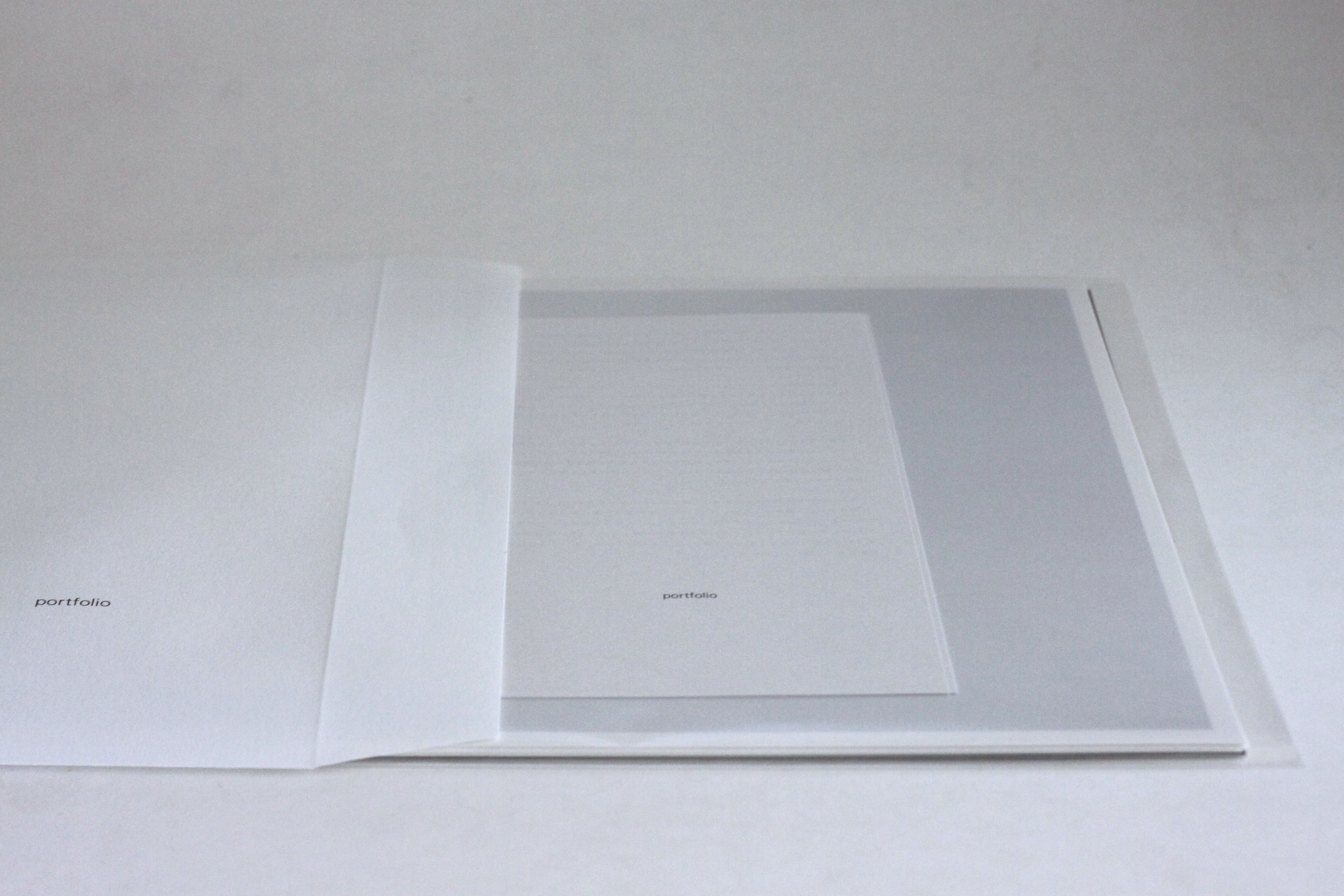
Portfolio - '21 works -


haruna morita
Portfolio - '21 works -


B4サイズ・15カット収録。
A4テキスト冊子付
オリジナル封筒仕様。


昨年末(’21)に記録した作品群の一部を抜粋し
ポートフォリオに仕上げました。

レイアウト・デザインは、鎌田充浩さん。


テキストを、セラピストの佐藤直昭さんに依頼。
快く受けていただき、感謝。


数十冊限定の制作。
親しい方々やお世話になった方々にお渡しするほか
展示会等で少数部販売も致します。(¥3,500)

完売いたしました